A road sign in Burgundy started it. In 1969 two Stellenbosch farmers on holiday in France saw a sign for a route des vins, came home, and two years later opened the country's first wine route. More than half a century on, the Stellenbosch wine route has roughly 150 member cellars, and the hardest part of a visit is no longer finding a farm that will pour for you. It is choosing which of them to see in a day.
The answer is the route's five sub-routes. Each covers one wedge of country around the town, and each has its own character, from the red-wine farms under the Simonsberg to the mountain cellars of Jonkershoek and Banhoek. This guide explains how the sub-routes work, which farms sit on each, and how to get around them with or without a car.
What the Stellenbosch Wine Route is
The Stellenbosch Wine Route is a membership organisation of wine farms around the town of Stellenbosch, set up to bring visitors to the cellars. It was the first wine route in South Africa, and today its members range from historic estates to small boutique cellars, with around 150 in all.
It began with three farmers. In 1969 Frans Malan of Simonsig and Niel Joubert of Spier were visiting Burgundy when they came across a modest route des vins at Morey-Saint-Denis, where the domains opened their doors to passing visitors. Back home they won over their friend Spatz Sperling of Delheim, and in April 1971 the authorities approved the Stellenbosch Wine Route with 11 members.
It was not an easy start. At the time most farmers sent their grapes to co-operatives, and selling wine straight from the farm to the public was close to unheard of. Liquor rules meant the route was only allowed to put up road signs in 1975, and the first signs carrying the route's logo were approved only in 1981. By its 21st birthday in 1992 the route had 24 members. The growth since then has been rapid, and wine routes have since been set up in nearly every wine region in the country.
The route did more than put up signs. Its members held the first Stellenbosch food and wine festival in 1973, played a part in the adoption of the Wine of Origin system that same year, and in 2014 opened a dedicated visitor centre in the middle of town. If you arrive without a plan, the visitor centre and the tourism office on Church Street are good places to pick up a map of the sub-routes.
How the five sub-routes work
With well over a hundred members, the route was divided in 2002 into five sub-routes: Greater Simonsberg, Stellenbosch Berg, Stellenbosch Valley, Bottelary Hills and Helderberg. At the same time the organisation added an s to its name and became the Stellenbosch Wine Routes.
The sub-routes are drawn by physical location, not by the official Wine of Origin wards that appear on labels, so a farm's sub-route tells you where it is, not what is printed on its bottles. Seen on a map, they look like wedges radiating out from the town, bounded by the N1 highway to the north, the Hottentots Holland mountains to the east, False Bay to the south and the Cape Town metro to the west.
That shape is the key to planning. Most of the farms on one sub-route are on the same side of town and often on the same road, so a day spent on one wedge means less driving and more time tasting. Trying to cover two or three in a day means crossing back through town each time. The route's own site lists every member on each sub-route; the farms below are among the best-known in each area.
Greater Simonsberg: red wine under the mountain
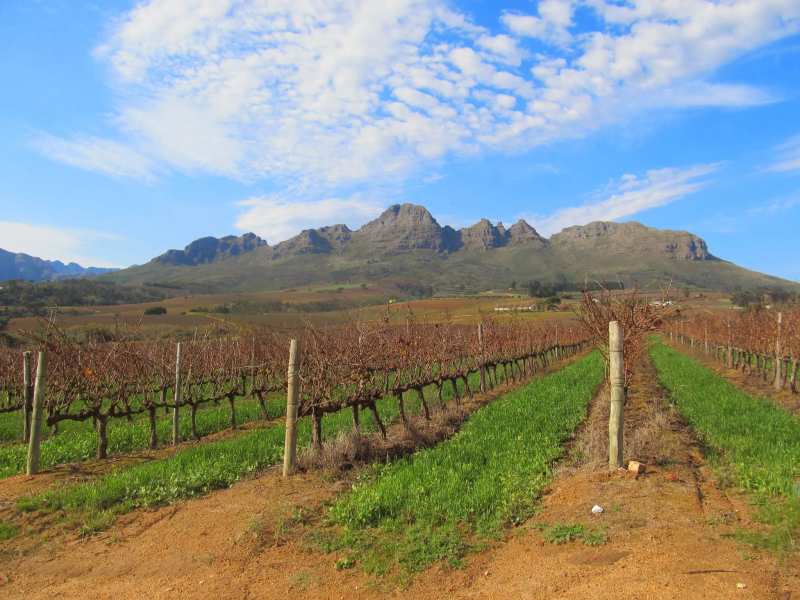
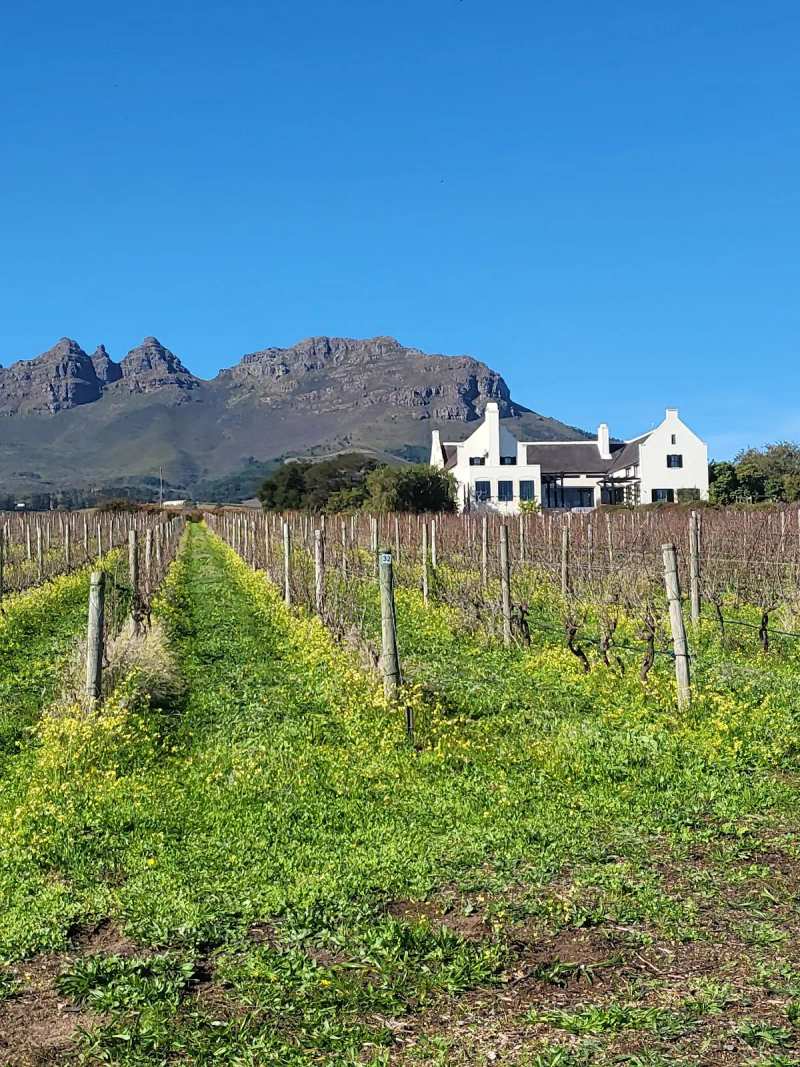
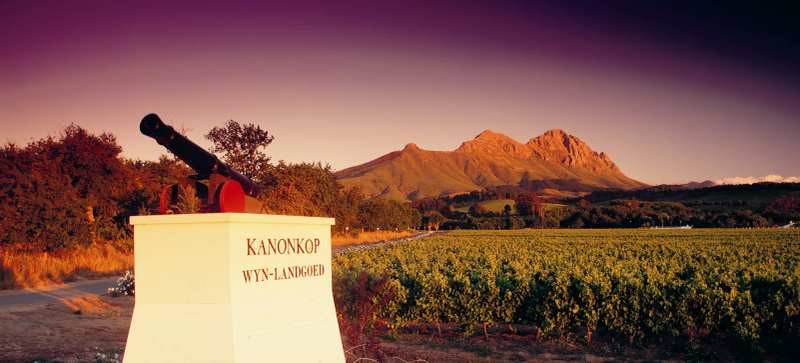
Greater Simonsberg covers the farms north of town on the lower slopes of the Simonsberg, the mountain between Stellenbosch and Paarl. It is often called Cabernet country, and its reputation rests on red wine: Cabernet Sauvignon, Bordeaux-style blends and Pinotage from old, well-established estates.
Along the same stretch, Warwick’s vineyard safaris take visitors out into the vines, and the farm's picnics on the lawn make it an easy stop for a group. Close by, Muratie’s old cellar is one of the most atmospheric tasting rooms in the region, a cobwebbed space on a farm whose history goes back to the 1680s.
Spatz Sperling’s Delheim is part of the route's own story as one of its three founding members, and still a family farm. At the southern edge of the sub-route, on the Helshoogte Pass road toward Franschhoek, the Tokara tasting room has one of the most dramatic views on the whole route, across the vineyards to the mountains.
Right at the top of the pass, Thelema sits on the south-eastern slopes of the Simonsberg, on a farm the Webb and McLean families bought in 1983. Its vineyards climb to around 530 m, among the highest and coolest in Stellenbosch, and Thelema’s patio tastings let you compare the farm's own wines with those of its sister label, Sutherland, made from cool-climate Elgin fruit.
Two more farms tell the route's story. Frans Malan’s Simonsig is where the route's co-founder made the country's first bottle-fermented sparkling wine from the 1971 harvest, released as Kaapse Vonkel, and the farm still makes it. Not far away, the Beyerskloof farm is devoted to Pinotage, with a restaurant built around the grape. Both sit on the north-western side of the sub-route, and both have restaurants, which makes them good lunch stops.
Spend a day here if red wine is the priority. The farms are close together along the R44 and the roads off it, and the heavy hitters are within a few kilometres of each other.
Stellenbosch Berg: Jonkershoek and Banhoek
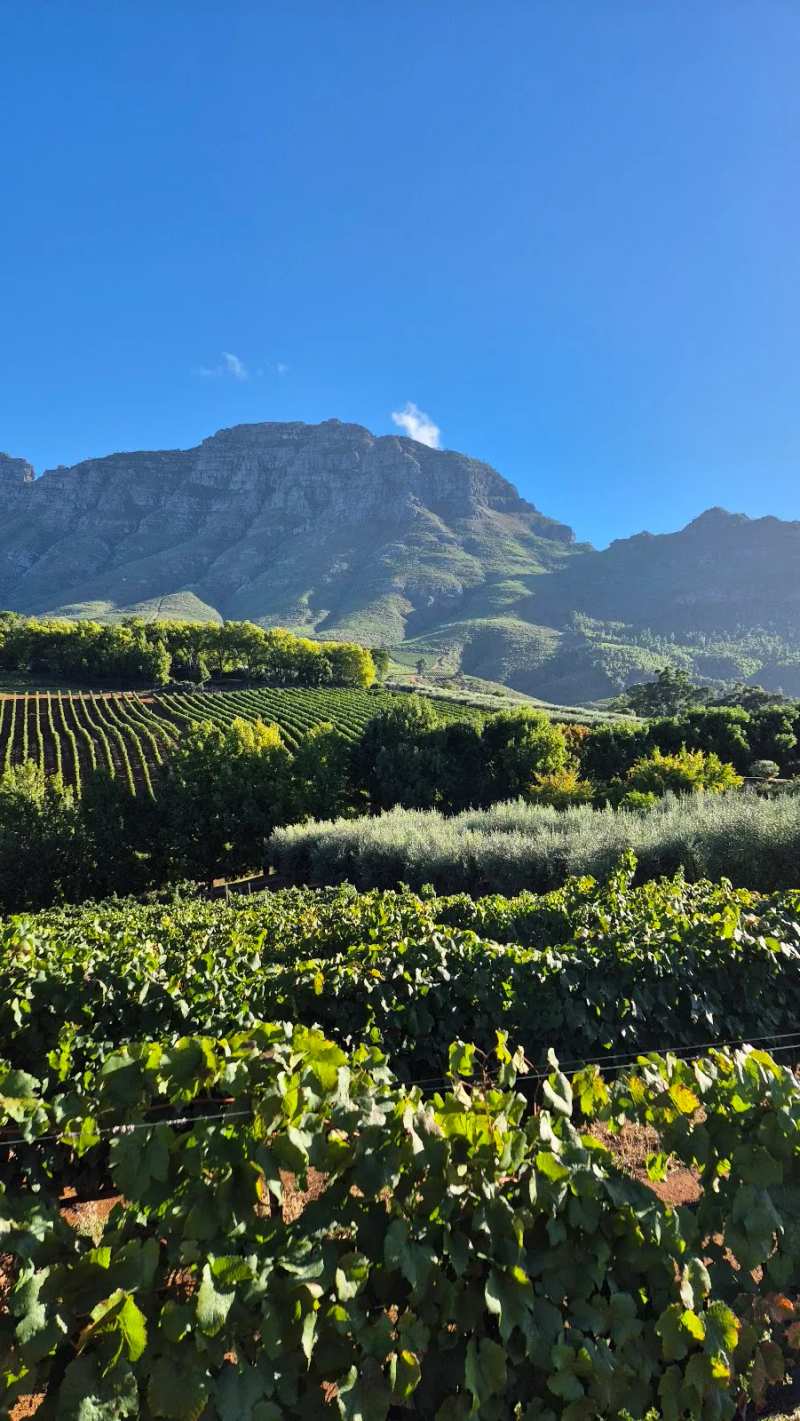
Stellenbosch Berg, the mountain sub-route, covers the farms east of town in the Jonkershoek valley and the Banhoek valley over the Helshoogte Pass. The farms sit in narrow valleys under high mountains, and the scenery is some of the most dramatic in the Winelands. The sub-route is known for Cabernet Sauvignon and Chardonnay.
Closest to town, about 3 km east at the mouth of the Jonkershoek valley, the Lanzerac estate is a historic farm with a hotel, a spa and restaurants, and a place in wine history: it put the first bottle labelled Pinotage on the market in 1959. Its tastings are an easy first stop on a day heading out of town.
Up the Helshoogte Pass, about 6 km out, Delaire Graff on the Helshoogte Pass is one of the most luxurious farms on the route, with lodges, a spa and two restaurants overlooking the valley.
The Banhoek farms are close enough together to walk between with a guide, which is the idea behind the guided wine walk described below. Combine the Berg with the Greater Simonsberg if you are driving, since the Helshoogte Pass links the two, with Tokara and Thelema at the top.
Stellenbosch Valley: the farms south-west of town
Stellenbosch Valley covers the farms south-west of town, toward the R310 and the Cape Town side of the region. It is gentler, rolling country with the big historic estates, some of the route's busiest visitor farms, and strong Cabernet Sauvignon and Chardonnay.
About 11 km west of town, the Jordan farm has a restaurant that was among those starred in Eat Out's 2026 awards, with a daily-changing menu and mountain views from the patio. Further south, about 13 km from town, the Meerlust estate has been in the Myburgh family since 1756 and makes Rubicon, its flagship Bordeaux-style blend.
Closer to town on the Spier side, the Neethlingshof farm is known for its wine garden and a deli serving pizzas, and it is a regular stop on the hop-on routes.
On the R44 just south of town, in the small Blaauwklippen valley, three more farms make an easy cluster. The Waterford estate is known for its Cabernet Sauvignon and its wine and chocolate pairing, and the Rust en Vrede farm, dating from 1694, has a restaurant starred in Eat Out's 2026 awards.
Next to them, the Blaauwklippen farm, granted in 1682, is one of the area's most child-friendly farms, so the cluster works for a mixed group.
The Valley is also the sub-route for food. Several of the farm restaurants worth planning a day around are on this side of town, so plan lunch here if eating well is part of the day.
Bottelary Hills: west toward Cape Town
Bottelary Hills covers the farms on the Bottelary road and the hills west of town, in the direction of Cape Town. It is one of the quieter sub-routes, and it is especially known for Pinotage, the grape South Africa created.
About 14 km west of town, Hazendal’s gardens are one of the best reasons to come out this way. The farm dates from 1699 and now has a luxury hotel, restaurants, children's activities, landscaped gardens by Leon Kluge, an organic Harvest Garden and a collection of vintage cars, enough to fill a day on one farm.
Nearby, the Saxenburg farm has wild animals roaming parts of the property, which gives a tasting there a safari feel, and there is accommodation for an overnight stay. Bottelary sits on the Cape Town side of town, which makes it a good option for a shorter day out of the city.
Helderberg: the southern farms
The Helderberg sub-route covers the farms south of Stellenbosch around Somerset West, on the slopes of the Helderberg mountain looking toward False Bay. It has some of the oldest farms in the region and a good balance of white and red wine. The area has enough farms for a separate day, so the Helderberg farms around Somerset West are mapped out on their own.
Doing the route without driving
You do not need a car or a designated driver to see the route. There are hop-on hop-off services, a wine tractor, a guided walk and private guides, all based in or near the town.
The Vinehopper is a hop-on hop-off minibus that runs set routes through the farms, each stopping at up to six estates. It collects from guesthouses in central Stellenbosch and from the tourism office on Church Street, and you choose which farms to get off at and how long to stay. The northern route takes in farms under the Simonsberg with good restaurants, while the southern route covers farms such as Spier and Van Ryn’s brandy cellar, where the tours include the cooperage. Tastings are paid separately at each farm, and since most farms close at around 5pm, the earlier you start, the more you see. The operator suggests choosing about four farms for a relaxed day.
The Stellenbosch Wine Tractor is a hop-on hop-off tour by tractor through the back roads and vineyards of the farms toward the Helderberg, with guides who explain the area as you go. You get about an hour at each farm before the tractor moves on, tastings are paid separately, and most of the farms on the route have something for children. It is a novel way to see the route, and slower than a minibus by design.
The Stellenbosch Wine Walk is a guided walking tour through the Banhoek valley, with tastings at Tokara, Thelema and Zorgvliet along the way and a guide to explain the history and the scenery. It is the way to see the mountain farms at a slower pace, and it gives the day a proper walk between tastings.
At Spier, Segway rides through Spier’s vineyards run for one or two hours and include the farm's regenerative farming and its animals. For a private or shared day built around your interests, Winelands Guide runs guided tours of the Winelands from Stellenbosch.
Planning your day on the route
You can also choose by what is in the glass. For Pinotage, head to Bottelary Hills or to Kanonkop and Beyerskloof under the Simonsberg. For Cabernet Sauvignon and Bordeaux-style blends, Greater Simonsberg is the obvious choice. For Chardonnay alongside Cabernet, the Berg and the Valley both deliver, and for a spread of whites and reds in one day, the Helderberg farms cover both. Most farms pour more than one style, so this is a starting point rather than a rule.
Pick one sub-route for each day. Greater Simonsberg is for red wine lovers, Stellenbosch Berg for mountain scenery and the big views, Stellenbosch Valley for historic estates and lunch, and Bottelary Hills for a quieter day. If you are travelling with children, Spier and Hazendal are the two farms with the most to keep them busy.
Three or four farms make a full day, with lunch at the second or third. Tastings at most farms need no booking for small groups, but cellar tours, pairings and the popular farm restaurants should be booked ahead, especially on summer weekends. If you are driving yourself, agree on a non-drinking driver before you start.
The town itself makes a good base. Stellenbosch has hotels and guesthouses within reach of every sub-route, and the hop-on services start from the centre. For a closer look at Stellenbosch's best farms, one by one, the farms on each sub-route are described in more detail.
When to go
The route is open all year, but the seasons change the experience. Summer, from December to February, is the busiest time, when the popular farms and their restaurants fill up and booking ahead matters. Harvest runs from about February to April, when the farms are at their busiest in the cellar and you have the best chance of barrel tastings and winemakers on hand. March and April are the sweet spot, with softer temperatures and fewer visitors than high summer. Winter is quieter and wetter, and the easiest time to get a table without booking far ahead.
And if you have more than a day or two in the Winelands, Stellenbosch combines easily with the Western Cape's other wine valleys, starting with Franschhoek over the Helshoogte Pass and Paarl to the north.
Frequently asked questions
Published August 24, 2026