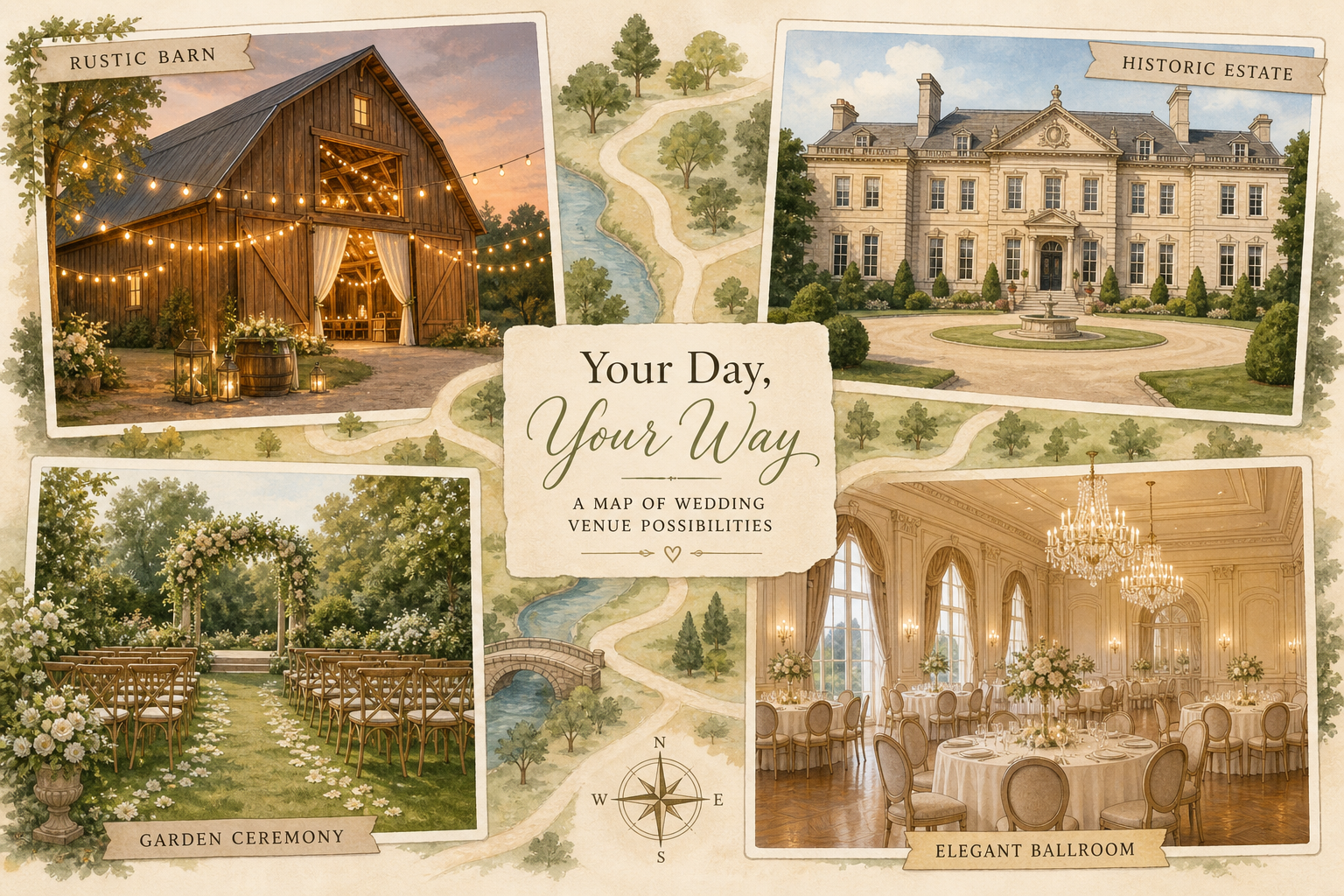
The venue sets the boundaries for almost every other decision, from guest count and catering to timeline and the largest share of your total spend.
Find the right wedding venue in your area
Explore local wedding venues on Local Eyes and find the setting that fits your vision and guest list.
The venue shapes everything else about your wedding
Before you book a photographer or taste a single cake, the venue sets the boundaries for almost every other decision. It determines your guest count, your catering options, your timeline, and a large share of your total spend. Most couples allocate between 20 and 40 percent of their total wedding budget to the venue alone, making it the single largest line item in the wedding services industry. That proportion holds whether you are planning an intimate dinner for thirty or a ballroom celebration for three hundred. Starting with the venue is not just conventional wisdom; it is the practical sequence that makes every downstream decision easier.
Venue types range far beyond the ballroom
The most popular choice is the dedicated banquet hall, selected by roughly 20 percent of couples, followed closely by farms and barns at around 18 percent. Historic buildings and mansions account for about 14 percent of weddings. Beyond those three, couples also marry in private clubs, museums, restaurants, wineries, hotel ballrooms, outdoor gardens, and raw industrial spaces. Each category carries its own character, infrastructure, and set of trade-offs. A winery, for example, typically offers a built-in aesthetic and on-site catering, while a barn may require bringing in everything from portable restrooms to a generator. Knowing what a venue type typically includes, and what it does not, is the first filter to apply.
All-inclusive versus raw space is the most consequential distinction
An all-inclusive venue bundles the event space, tables and chairs, in-house catering, bar service, basic décor, and sometimes a day-of coordinator into a single package. A raw space provides four walls and a floor; every vendor, every table, every fork is your responsibility to source. The planning complexity difference is significant. All-inclusive venues can simplify logistics considerably, but they come with their own hidden costs: service charges of 18 to 25 percent on food and beverage totals are standard practice and are often buried in the contract rather than mentioned upfront. Mandatory gratuities, cake-cutting fees, and corkage fees for outside wine are also common. Read the contract in full before comparing any two venues on headline price alone.
Location and region shift what you will pay
Venue costs vary sharply by geography. Urban venues command meaningfully more than suburban or rural counterparts, and regional differences compound that gap further. The Mid-Atlantic region leads the country in average venue spend, followed by New England, while the Midwest tends to sit lower. New Jersey consistently ranks as one of the most expensive states for weddings overall. These regional patterns matter when you are comparing venues across a metro area: a venue thirty minutes outside the city center may offer comparable amenities at a noticeably different price point, though you will need to factor in guest travel and parking.
The questions you ask before signing protect you later
A venue visit is an interview, not a tour. The practical questions that matter most include: What is the maximum guest capacity, and is there a minimum? What are the noise ordinance cutoff times? Is parking on-site, and is it accessible for guests with mobility needs? Are you required to use in-house catering, or can you bring outside vendors? Is there a minimum food and beverage spend? What does the cancellation and rescheduling policy look like? Vendor restrictions are a particularly common surprise: some venues require you to choose from an approved list of caterers, florists, or DJs, which limits your flexibility and can affect your overall spend. Getting clear answers in writing before you sign is the single most effective way to avoid budget overruns.
How to find and book the right venue
- 1
Set your guest count and date range first
Capacity is the hardest constraint to work around after the fact. Before you contact a single venue, agree on a realistic guest count and identify two or three date ranges that work for your key family members. A venue that cannot accommodate your full guest list is not a venue option, no matter how beautiful the photos are. Having a date range rather than a fixed date also gives you negotiating flexibility.
- 2
Decide your venue style and must-haves
Make a short list of non-negotiables: outdoor ceremony space, on-site catering, a bridal suite, a dance floor, wheelchair accessibility. Then separate those from preferences. This distinction matters because mixing up must-haves and nice-to-haves is one of the most common reasons couples fall in love with a venue that does not actually work for them. Write the list before you start touring so you are evaluating venues against your criteria, not against each other.
- 3
Research venue types in your area
Use local guides, directories, and community platforms to map out what is actually available near you. Local Eyes organizes wedding venues by location alongside restaurants, wineries, private event spaces, and other local businesses, which makes it easier to understand the full landscape of a town or neighborhood before you commit to visiting. Seeing a venue in the context of its surroundings helps you assess logistics like parking, nearby accommodation for out-of-town guests, and the overall feel of the area.
- 4
Visit shortlisted venues and ask the hard questions
Schedule in-person visits for your top three to five venues. Bring your list of must-haves and the contract questions from the section above. Ask specifically about service charges, vendor restrictions, and what happens if your guest count changes. Take notes immediately after each visit while the details are fresh; venues blur together quickly when you are touring several in a short period.
- 5
Read the contract line by line before signing
Service charges, mandatory gratuities, cake-cutting fees, and corkage fees are standard in the industry and are frequently not mentioned during the sales conversation. The contract is where the real cost of a venue lives. If anything is unclear, ask for written clarification. A reputable venue will answer contract questions without pressure.
- 6
Confirm logistics and lock in your vendors
Once you have signed, confirm the practical details in writing: load-in and load-out times, vendor access windows, parking arrangements, and the name of your day-of contact. If the venue has a preferred vendor list, request it early so you have time to vet those vendors. Locking in your caterer, bar service, and any rentals shortly after booking the venue keeps your planning timeline on track.
Benefits
Venue type shapes your whole plan
The venue you choose determines your guest capacity, catering options, vendor flexibility, and a large share of your total spend. Choosing the right venue type first prevents costly mismatches later in the planning process.
All-inclusive packages reduce coordination work
Bundling catering, bar service, and basic décor into a single venue contract means fewer vendors to manage and a more predictable planning process. The trade-off is less flexibility over individual elements like menu and décor style.
Hidden fees are standard, not exceptional
Service charges of 18 to 25 percent on food and beverage are common across the industry and are frequently not disclosed during the initial venue conversation. Reading the contract carefully before signing is the most reliable way to understand the true cost.
Location affects more than just scenery
Urban venues consistently command higher costs than suburban or rural ones, and regional variation is significant across the country. Considering venues slightly outside a city center can open up options with comparable amenities and better parking and accommodation logistics for guests.
Vendor restrictions limit your flexibility
Many venues require couples to use an approved vendor list for catering, bar service, or other services. Knowing about vendor restrictions before you sign lets you assess whether the approved vendors meet your standards and budget expectations.
Real situations where venue type makes a difference
A large guest list in a mid-size city
A couple expecting a guest list of several hundred people in a mid-size city will quickly find that capacity is the dominant filter. Banquet halls and hotel ballrooms are the most common solution at this scale because they are purpose-built for large events and typically include tables, chairs, and in-house catering. The trade-off is a more standardized aesthetic. Asking about minimum food and beverage spends is especially important at this scale, since those minimums can be substantial and are not always disclosed upfront.
An intimate outdoor ceremony at a local winery
Wineries have become a popular venue choice because they offer a built-in setting, on-site catering, and a defined visual character without requiring extensive decoration. For a smaller guest list, a winery can simplify planning considerably. The key questions to ask are whether the venue has a noise ordinance cutoff and what the rain contingency plan is, since outdoor spaces depend heavily on weather. Local Eyes lists wineries alongside their event capabilities, making it easier to identify which ones actively host weddings.
A historic estate with outside vendors
Historic buildings and mansions account for about 14 percent of wedding venue choices and appeal to couples who want a distinctive architectural backdrop. Many historic venues operate as raw spaces, meaning they provide the setting but require you to hire all vendors separately. This gives you full control over catering and decor but adds significant coordination work. Confirm early whether the venue has restrictions on what can be attached to walls or floors, as preservation requirements are common in historic properties.
A barn or farm wedding with full vendor sourcing
Farms and barns are the second most popular venue type, chosen by around 18 percent of couples. Their appeal is the relaxed, photogenic setting, but they are often the most logistically demanding option. Many barn venues require couples to bring in portable restrooms, generators, lighting, and sometimes even a commercial kitchen setup. Treat a barn venue like a raw space even if it is marketed otherwise, and build a detailed vendor checklist before you commit.
Common questions about wedding venues
Explore wedding venues in your town on Local Eyes
Finding the right wedding venue starts with knowing what is actually available in your area. Local Eyes lists wedding venues alongside restaurants, wineries, and private event spaces so you can explore your options in one place and get a real sense of what each location offers before you schedule a visit.