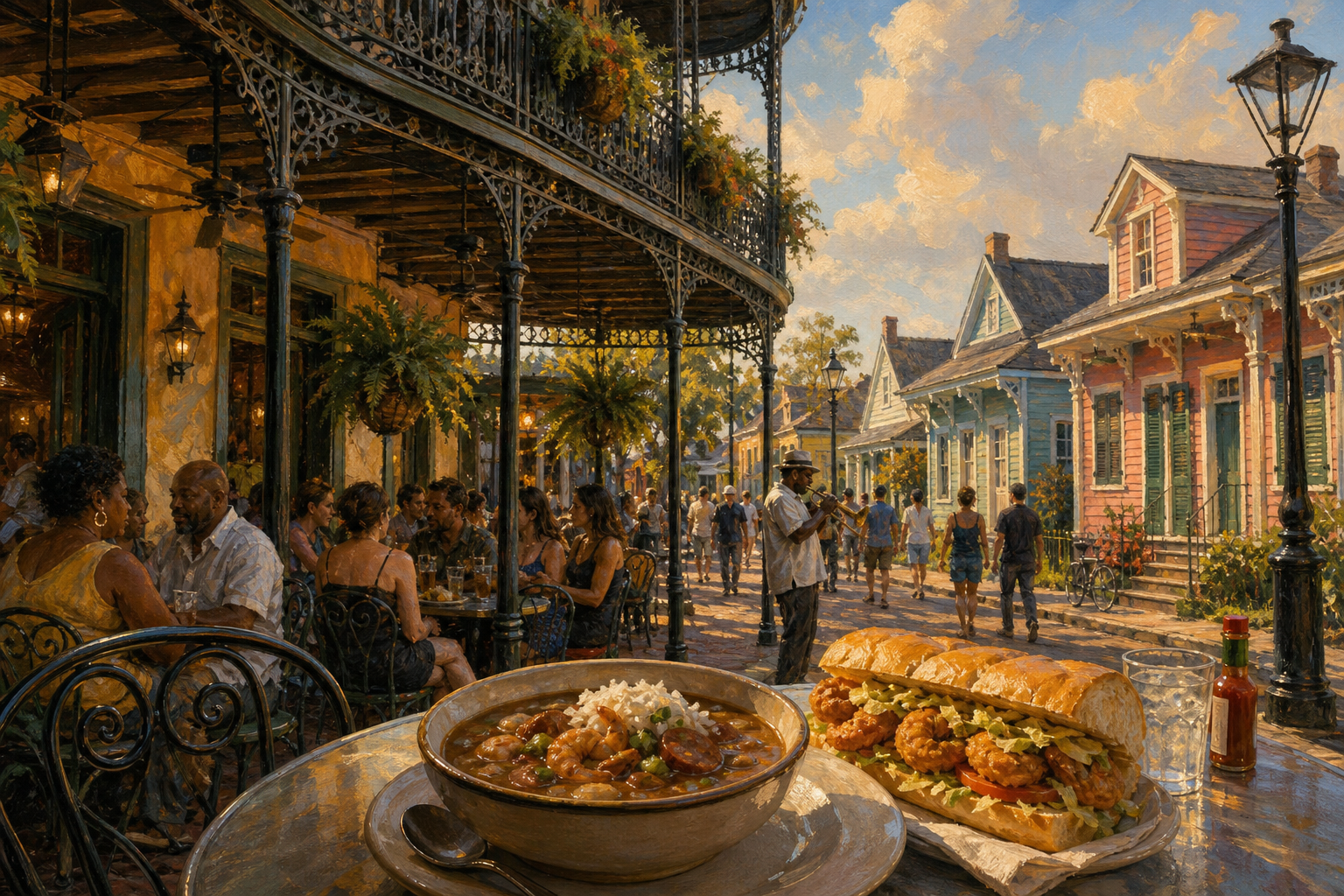
In New Orleans, the food has had three hundred years to settle into something that feels genuinely rooted rather than performed.
Find the best New Orleans restaurants near you
Discover the restaurants, markets, and food events that locals actually talk about on Local Eyes.
Why New Orleans food is unlike anywhere else in America
The city's cuisine is the product of centuries of layered influence. French and Spanish colonial cooking, West African culinary technique, Native American ingredients, German and Italian immigrant traditions, and Caribbean flavors all converged in one place and never fully separated. The result is a genuinely distinct food culture that has been building on itself for over three hundred years. Gumbo alone carries traces of African okra-thickening traditions, French roux technique, Spanish spice, and Native American filé powder. That kind of depth is not recreated elsewhere. What makes dining here feel different is not novelty but continuity. Institutional restaurants like Antoine's, which opened in 1840, Commander's Palace, and Galatoire's have been serving versions of the same dishes for generations, which means the food has had time to settle into something that feels genuinely rooted rather than performed.
The dishes every visitor should understand before ordering
Knowing what you are ordering makes the meal better. Gumbo is a roux-thickened stew built around seafood, chicken, or sausage, and it varies significantly from kitchen to kitchen. Jambalaya comes in two main forms: Creole jambalaya includes tomatoes, Cajun jambalaya does not, and each produces a noticeably different flavor. Po'boys are built on French bread and filled with fried seafood or roast beef debris, with origins traced to a 1920s sandwich shop that fed striking streetcar workers. Crawfish étouffée is a butter-rich smothered dish best ordered when crawfish are in season, roughly February through mid-May. Beignets, fried dough dusted heavily in powdered sugar, arrived with French immigrants in the 18th century and remain a morning staple. Charbroiled oysters, dressed with butter, garlic, and cheese, are a more recent local invention that has become its own institution.
Where you eat matters as much as what you order
The French Quarter is the obvious starting point, and it contains some of the city's most historic restaurants. But Bourbon Street specifically is tourist-heavy and quality varies widely. A short walk into the Marigny or Bywater changes the experience considerably. These neighborhoods attract visitors partly for their colorful Creole cottages and lively streets, but the dining is also genuinely strong, with kitchens that tend to cook for a local audience rather than a transient one. Uptown and Mid-City reward the extra travel time with neighborhood spots serving red beans and rice, gumbo, and po'boys at the kind of casual, unhurried pace that defines everyday New Orleans eating. The Garden District sits between the tourist core and the residential neighborhoods and is home to Commander's Palace, a James Beard Award-winning restaurant that launched the careers of chefs Emeril Lagasse and Paul Prudhomme and still produces some of the city's finest Creole cooking.
Fine dining, casual spots, and everything in between
New Orleans has a wider range of dining registers than most cities its size. At the formal end, white-tablecloth Creole restaurants in the French Quarter and Garden District offer multi-course meals built around classical technique and local ingredients. At the other end, neighborhood diners and lunch counters serve the same dishes in paper-lined baskets with no pretense. Both ends of the spectrum are worth experiencing. The city also has a growing number of restaurants doing creative, technically precise work with French and Creole technique. MaMou, which opened in 2022, earned early attention for exactly that kind of cooking. For visitors with dietary restrictions, many kitchens now offer vegetarian or vegan interpretations of gumbo, po'boys, and jambalaya, though these remain exceptions rather than the rule in traditional spots.
Practical things to know before you go
Reservations matter more than many visitors expect, particularly at well-known spots in the French Quarter and Garden District on weekend evenings. Walk-in lunch is generally more forgiving than dinner. The standard tip at New Orleans restaurants is 15 to 20 percent, consistent with national norms. Dress codes at historic fine dining rooms are real and enforced, so checking ahead saves awkwardness. If you are visiting in spring, prioritize crawfish dishes while they are in season. Food markets and festivals are woven into the city's calendar year-round and are often the best way to sample multiple styles of cooking in one sitting. Local Eyes lists current farmers markets and food events across the city if you want to plan around what is happening during your visit.
How to plan a great meal in New Orleans
- 1
Decide which neighborhood fits your day
Start by matching the neighborhood to your plans rather than defaulting to wherever you are staying. The French Quarter is convenient and historically rich, but Uptown, Mid-City, and Bywater tend to offer more relaxed, locally oriented meals. If you have a car or are willing to take a short ride, the extra distance is almost always worth it.
- 2
Learn the seasonal and daily rhythms
Crawfish dishes are best from February through mid-May when the season is active. Red beans and rice is a Monday tradition in New Orleans kitchens, a holdover from the days when laundry was done on Mondays and a pot of beans could simmer unattended. Knowing these rhythms helps you order what is freshest and most authentic on any given day.
- 3
Match the restaurant to the occasion
A long, celebratory lunch at a historic Creole institution is a different experience from a quick po'boy at a neighborhood counter, and both are worth having. Fine dining rooms like Commander's Palace expect reservations, appropriate dress, and a slower pace. Casual spots often operate on a first-come basis and move quickly. Decide what kind of meal you want before you search, not after.
- 4
Check menus for what is actually made in-house
In a city with this much food mythology, some restaurants trade on reputation rather than current quality. A useful filter is whether the kitchen is making its roux, its bread, and its stocks from scratch. Menus that change with the season and feature local suppliers are generally a better signal of a kitchen that is paying attention.
- 5
Build in at least one unplanned meal
Some of the best eating in New Orleans happens when you follow a smell, a line, or a local's offhand recommendation. Street food, pop-ups, and market stalls are a genuine part of the food culture here, not a lesser alternative to sit-down dining. Leave one meal in your itinerary deliberately open.
Benefits
Over 300 years of culinary depth
New Orleans cuisine has been evolving since the early 18th century, with gumbo alone reflecting African, French, Spanish, and Native American influences layered over generations. That depth of history makes the food feel genuinely rooted rather than trend-driven.
Iconic dishes with traceable origins
Every major dish on a New Orleans menu has a specific story. Po'boys trace back to a 1920s sandwich shop feeding striking streetcar workers; beignets arrived with French immigrants in the 18th century. Understanding the origins makes the food more meaningful to eat.
Neighborhood variety beyond the tourist core
The Marigny, Bywater, Uptown, and Mid-City neighborhoods offer locally oriented restaurants that cook for residents rather than tourists, producing a more authentic and often more adventurous dining experience than the busiest parts of the French Quarter.
Institutional restaurants with genuine staying power
Antoine's has been open since 1840. Commander's Palace has launched the careers of nationally recognized chefs. These are not museums but working restaurants still producing serious Creole cuisine, and a meal at one connects you to a living culinary tradition.
A dining calendar shaped by seasons and tradition
Crawfish season from February to mid-May, Monday red beans and rice, and a year-round calendar of food festivals mean that when you visit shapes what you eat in ways that reward planning and reward spontaneity in equal measure.
Dining situations New Orleans handles particularly well
A first-time visitor covering the classics
A visitor with two or three days who wants to understand what New Orleans food actually is should build an itinerary around the core dishes rather than the most-reviewed restaurants. A bowl of gumbo at a neighborhood spot, a po'boy at a counter that has been making them for decades, beignets in the morning, and one dinner at a historic Creole institution covers the essential range. Spreading meals across neighborhoods rather than staying in the French Quarter gives a much more complete picture of the city's food culture.
A spring visit timed around crawfish season
Crawfish season runs roughly from February through mid-May, and a visit timed to that window opens up a significant part of the menu that is unavailable or inferior the rest of the year. Crawfish étouffée, crawfish bisque, and boiled crawfish by the pound are all worth prioritizing. Neighborhood seafood spots and casual boil houses tend to do this better than formal restaurants, and the experience of eating boiled crawfish at a picnic table is itself part of what makes the trip.
A group with mixed dietary needs
Traveling with vegetarians or vegans in a meat-and-seafood-heavy food city requires some advance planning. Many New Orleans kitchens now offer plant-based versions of gumbo, po'boys, and jambalaya, but these are more common in the Marigny, Bywater, and Uptown neighborhoods than in the traditional French Quarter institutions. Checking menus online before arriving saves the table from a difficult conversation mid-service.
A local resident exploring beyond their usual spots
Long-time residents often have a handful of reliable favorites and rarely venture beyond them. The city's dining scene has expanded considerably in recent years, with newer kitchens like MaMou bringing technically precise, creative cooking to a city that already had strong foundations. Using a local guide to track what has opened recently is the most reliable way to find restaurants worth adding to the regular rotation.
New Orleans restaurants: questions locals get asked most
Find where locals eat in New Orleans
New Orleans has one of the deepest food cultures in the country, and the best way to navigate it is with recommendations from people who actually live and eat here. Browse Local Eyes to find restaurants, food events, and farmers markets in New Orleans that locals are talking about right now.