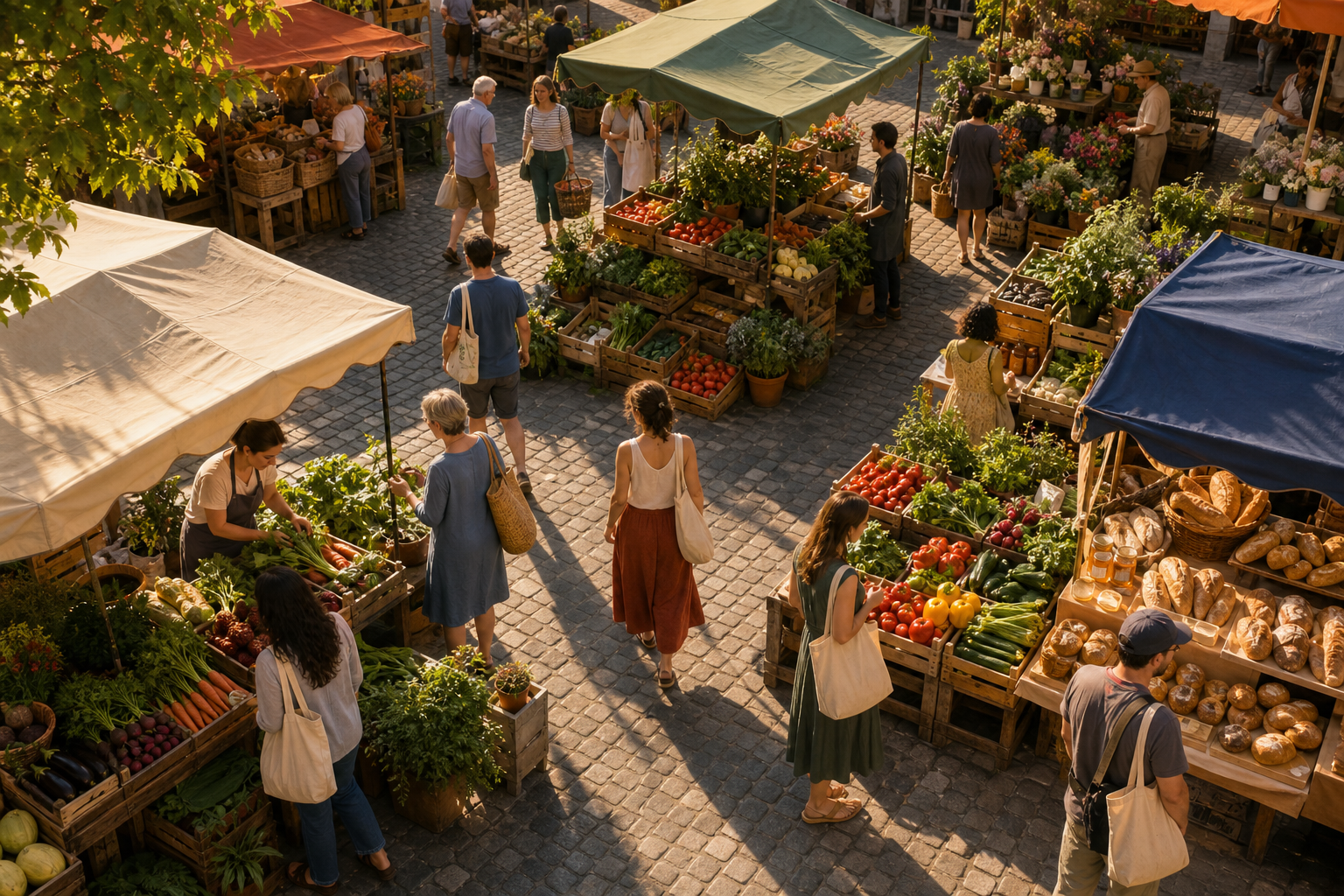
The people selling at a farmers market are often the same people who planted, tended, and harvested what is in front of you.
Find local farmers markets in your town
Discover the farmers markets in your area and start shopping directly from local growers this week.
What a farmers market actually is
A farmers market is a recurring marketplace, outdoors or indoors, where local growers, producers, and artisans sell directly to shoppers. There is no middleman, no distribution center, and no long cold chain between farm and table. The person behind the table usually grew, raised, or made what they are selling. Markets run on a fixed schedule, most commonly one or two set days per week, typically morning to early afternoon, in a central community space such as a town square, park, or parking lot. The goods on offer go well beyond vegetables: expect meat, dairy, eggs, baked goods, preserves, honey, flowers, and often handmade crafts depending on the market's rules.
How many markets exist and where to find them
The United States has a substantial and growing network of markets. The USDA National Farmers Market Directory listed 8,140 farmers markets in 2022, up from just 1,755 in 1994. Markets are most concentrated in the Northeast, Midwest, and West Coast, with California, New York, Michigan, Illinois, Ohio, and Massachusetts leading by count. The USDA directory is a reliable starting point for searching by zip code, but local community boards, town websites, and platforms like Local Eyes often carry more current details on hours, vendor lists, and seasonal changes that a national database may not reflect in real time.
Seasons and schedules vary more than you might expect
Most markets in the United States operate seasonally. Roughly 88 percent of markets are seasonal, open an average of 4.5 months per year, with the Northeast and Upper Midwest typically running from May or June through October or November. That said, the picture is changing: the number of year-round farmers markets reached 2,100 in 2023, up from 1,800 in 2020, and more than 880 markets across 47 states stay open during the November through March off-season. Southwest and Southern California markets tend to run year-round. Before making a trip, always confirm the current schedule directly, since markets can shift dates for holidays, weather, or venue conflicts.
Payment, SNAP, and what to bring
Cash remains the most universally accepted payment at farmers markets, but the landscape is shifting. Many markets now accept credit and debit cards, and thousands of markets across the U.S. accept SNAP benefits via EBT cards, with many also offering matching programs that effectively stretch those dollars further. In 2016, only 40 percent of markets accepted SNAP; acceptance has grown considerably since. Some markets run their own token or scrip system: you exchange cash or EBT at a central booth and use the tokens with any vendor. Not every individual vendor accepts cards or EBT directly, so carrying some cash as a backup is always practical.
Who sells at markets and what makes each one different
75 percent of U.S. farmers market vendors were small farms under 10 acres in 2022, and 42 percent of vendor operations were women-owned. Markets vary considerably in size and focus: a large urban market may have 50 or more vendors selling everything from grass-fed beef to sourdough to seedlings, while a smaller community market might have a dozen tables focused on seasonal produce. Some markets are strictly producer-only, meaning every vendor grew or made what they sell. Others allow resellers or prepared food. Knowing a market's rules before you go helps set expectations and lets you decide which markets match what you are actually looking for.
How to find and make the most of your local market
- 1
Search by location and season
Start with the USDA National Farmers Market Directory or a local community platform to find markets within a practical distance. Filter by season and day of week so you are only looking at markets that are actually open when you plan to visit. Confirm hours directly with the market or its social media before your first trip, since listings in national databases can lag behind real-world schedule changes.
- 2
Check vendor variety before you go
Not all markets carry the same range of goods. A market focused on produce may have no meat or dairy vendors; another may specialize in prepared foods and crafts. Most markets publish a vendor list or a seasonal guide on their website or social channels. Scanning it in advance lets you plan a route through the stalls and avoid a wasted trip if you are looking for something specific like pastured eggs or fresh-milled flour.
- 3
Understand the payment setup
Bring cash as a baseline, since it is accepted everywhere. If you use SNAP or EBT, look for a central market booth where tokens or scrip are issued, as many markets use this system rather than allowing direct EBT swipes at each stall. Ask the market manager about their payment system before or when you arrive; they are usually easy to find and happy to explain the process to first-time visitors.
- 4
Arrive early for the best selection
Most farmers markets run from morning to early afternoon, and the best selection of popular items, particularly bread, pastured meats, and specialty produce, tends to go early. Arriving within the first hour gives you access to the full range of what vendors brought that day. Later visits can still be worthwhile, and some vendors discount remaining stock near closing, but the variety will be narrower.
- 5
Build a relationship with vendors
One of the genuine advantages of a farmers market over a grocery store is the direct conversation you can have with the person who grew or made what you are buying. Ask about growing practices, what is coming into season next week, or how to prepare something unfamiliar. Regular customers often get first access to limited items or advance notice of what a vendor is bringing, simply because they asked.
- 6
Return consistently to understand the rhythm
A single visit gives you a snapshot; returning over several weeks reveals the market's seasonal rhythm. You will notice which vendors rotate in and out, what produce peaks when, and which stalls draw the longest lines. That pattern knowledge makes every subsequent visit more efficient and more rewarding. Markets also often host special events, themed days, or guest vendors, which a regular attendee is much more likely to catch.
Benefits
Produce harvested days before sale
Unlike grocery store supply chains that can span weeks, farmers market produce is typically harvested within days of the market date. Shorter time from field to table means better flavor, higher nutrient retention, and less food that spoils quickly at home.
Direct access to small, local farms
75 percent of vendors at U.S. farmers markets are small farms under 10 acres, giving shoppers access to producers who rarely appear in conventional retail. That scale means more variety in heirloom varieties, heritage breeds, and specialty crops that large distributors do not carry.
A growing network across the country
With 8,140 markets listed in the USDA directory in 2022 and more than 2,100 operating year-round as of 2023, there is a meaningful chance a market operates within a reasonable distance of most U.S. addresses, even outside major cities.
SNAP and EBT accepted at many markets
Thousands of markets accept SNAP benefits, and many pair acceptance with matching programs that increase purchasing power for EBT users. This makes farmers market shopping a realistic option across a wide range of household budgets.
A genuine community gathering point
Markets concentrate local producers, neighbors, and visitors in one place on a regular schedule. That consistency makes them one of the few recurring public spaces where a community's local food economy is visible and participatory.
Farmers market visits that look different in practice
A family new to the neighborhood
A household that has just relocated to a new town often uses the local farmers market as an early way to understand the community. The market reveals which farms operate nearby, what the growing season looks like in that region, and which neighborhoods are most active on a Saturday morning. Shopping at the market in the first weeks after a move is also a practical way to stock a kitchen with fresh staples while the grocery routine is still being established.
A shopper using SNAP benefits
For a shopper relying on SNAP, the key step is identifying which markets in the area have a central token booth and whether they offer a matching program. Many markets that accept EBT also run incentive programs that provide bonus tokens on top of what is loaded, making the market genuinely competitive with grocery store prices for fresh produce. Calling or messaging the market manager ahead of the first visit clarifies exactly how the system works at that specific location.
A visitor exploring a town for a weekend
A traveler spending a weekend in an unfamiliar town often finds that the Saturday morning farmers market is one of the most efficient ways to get a sense of the place. The vendor mix, the local specialties on offer, and the general atmosphere reflect the town's character in a way that a restaurant or shop may not. Picking up local honey, a regional cheese, or a jar of preserves also makes for a more meaningful souvenir than something from a gift shop.
A home cook focused on seasonal eating
A cook who builds meals around what is in season benefits most from a weekly market habit. Because produce at a farmers market is typically harvested within days of sale, it is at or near peak flavor and nutrition. Over the course of a year, shopping the market trains an intuition for what grows when, which in turn shapes how a home cook plans menus, reduces food waste, and cooks more confidently with unfamiliar ingredients.
Farmers markets near you: common questions answered
Start exploring the farmers markets in your town
Local Eyes lists farmers markets by location alongside the vendors, events, and local businesses that make each town worth knowing. Browse the markets guide for your area to find days, hours, and what each market carries, then check back weekly as the season changes.